
NEW YORK, NY – Couples ending long-term marriages later in life often face unique legal and financial challenges that set their cases apart from other divorces. Manhattan divorce attorney Richard Roman Shum of the Law Office of Richard Roman Shum, Esq. (https://www.romanshum.com/blog/what-is-grey-divorce/) explains what grey divorce means under New York law and how courts handle asset division, spousal support, and retirement accounts when spouses are age fifty and older.
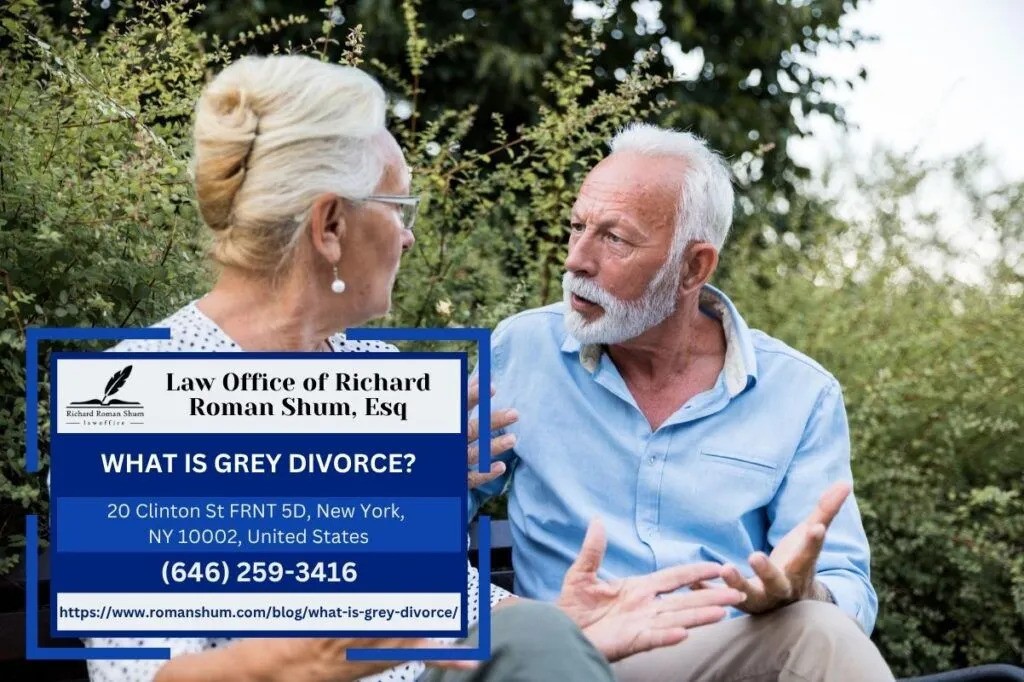
According to Manhattan divorce attorney Richard Roman Shum, grey divorce generally refers to the dissolution of a marriage involving spouses age fifty or older. Although the term does not have a specific legal definition under New York Domestic Relations Law, it is commonly used to describe later-in-life divorce cases that often involve decades of shared assets, intertwined retirement accounts, and detailed property arrangements. “These cases require careful attention because both spouses may have less time to rebuild financially after the marriage ends,” Shum explains.
Manhattan divorce attorney Richard Roman Shum notes that New York follows equitable distribution under DRL Section 236(B), which requires courts to divide marital property fairly based on the circumstances of each case. Marital property includes everything acquired by either spouse during the marriage, regardless of whose name appears on title, while separate property such as assets owned before the marriage or received as gifts or inheritances generally remains with the original owner unless it has been commingled with marital funds.
Attorney Shum points out that courts evaluate multiple statutory factors under DRL Section 236(B)(5)(d) when determining how to divide marital property. These include the duration of the marriage, each spouse’s income and earning capacity, the age and health of both parties, and whether either spouse sacrificed career opportunities for the benefit of the family. In grey divorce cases, the length of the marriage and each party’s proximity to retirement carry significant weight. “Fair does not necessarily mean equal, and the court looks at the totality of the circumstances,” Shum adds.
Spousal support, known as maintenance in New York, is often a central issue in grey divorces. A statutory formula under DRL Section 236(B)(6) provides a guideline amount for post-divorce maintenance, though judges have discretion to deviate based on the specific facts of each case. Shum explains that under New York’s advisory schedule, a marriage lasting more than twenty years may support maintenance for thirty-five to fifty percent of the length of the marriage, although courts must consider the statutory factors and may award non-durational maintenance in appropriate cases.
Retirement savings are often among the most valuable assets in a grey divorce. Pensions, 401(k) plans, individual retirement accounts, and other retirement vehicles funded during the marriage are generally considered marital property subject to equitable distribution. The firm notes that a Qualified Domestic Relations Order is commonly used to divide certain employer-sponsored retirement plans, while IRAs are handled differently under IRS guidance. “Because the rules differ by account type, retirement division should be structured carefully to avoid unnecessary taxes or penalties,” Shum observes.
Real estate is often the most valuable asset Manhattan couples own, and decisions about the marital home can define the outcome of a grey divorce. The firm frequently addresses cases involving cooperative apartments, condominiums, and rent-stabilized units, each of which brings its own set of legal considerations. Co-op ownership involves shares in a cooperative corporation and a proprietary lease rather than direct ownership of real property, and spouses seeking to remain in a co-op should review the building’s bylaws and governing rules early in the case.
Health insurance is another pressing concern, particularly when one spouse has relied on the other’s employer-provided coverage. Under federal law, a spouse who loses coverage through divorce may be eligible for continuation coverage under COBRA for up to thirty-six months, though the cost is typically much higher because the employer no longer subsidizes the premium. Shum advises that long-term planning for health insurance should be part of any grey divorce settlement, and costs may be factored into maintenance calculations or addressed through the overall property division.
For those facing a later-in-life divorce in Manhattan, consulting an experienced divorce attorney can help evaluate the division of retirement accounts, housing decisions, spousal support, and long-term financial planning. New York County divorce cases are filed at the New York County Supreme Court at 60 Centre Street.
About Law Office of Richard Roman Shum, Esq.:
Law Office of Richard Roman Shum, Esq. is a Manhattan-based law firm focused on family and divorce law, including high-net-worth separations, custody disputes, and later-in-life divorces. Led by attorney Richard Roman Shum, who has more than fifteen years of experience in family law, the firm serves clients throughout Manhattan and New York City from its office at 20 Clinton St FRNT 5D, New York, NY 10002. For consultations, call (646) 259-3416.
Email: richard@romanshum.com
Media Contact
.png)
Name
Law Office of Richard Roman Shum, Esq
Contact name
Richard Roman Shum
Contact phone
(646) 259-3416
Contact address
20 Clinton St FRNT 5D
City
New York
State
New York
Zip
10002
Country
United States
Url
https://www.romanshum.com/
