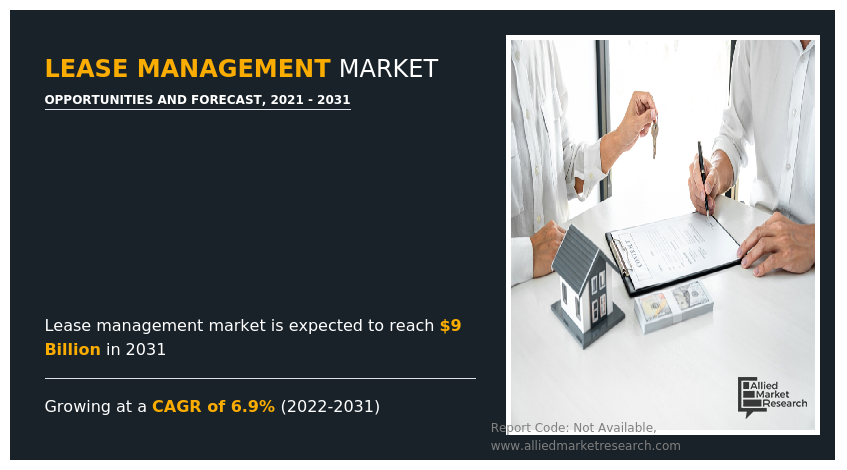
Lease Management Market is projected to reach $9 billion by 2031, driven by cloud adoption, IoT integration, and digital transformation initiatives.
WILMINGTON, DE, UNITED STATES, June 8, 2026 /EINPresswire.com/ — The global Lease Management Market is witnessing significant transformation as organizations increasingly adopt digital platforms to manage complex lease portfolios, streamline compliance requirements, and improve operational efficiency. According to a recent study published by Allied Market Research, the market was valued at $4.6 billion in 2021 and is projected to reach $9 billion by 2031, registering a CAGR of 6.9% from 2022 to 2031.
The growing complexity of lease agreements, evolving accounting standards, and increasing demand for centralized lease administration systems are encouraging enterprises across industries to invest in advanced lease management solutions. Modern lease management platforms help organizations manage lease contracts, automate payment schedules, monitor asset utilization, maintain compliance, and generate detailed financial reports from a unified environment.
Download PDF Brochure: https://www.alliedmarketresearch.com/request-sample/A31717
As businesses continue their digital transformation journeys, lease management systems are becoming indispensable tools for real estate operators, manufacturing companies, government agencies, educational institutions, retailers, and multinational enterprises. The integration of cloud computing, artificial intelligence, analytics, and Internet of Things (IoT) technologies is further reshaping the industry landscape.
Market Overview
The Lease Management Market encompasses software solutions and services designed to help organizations administer, track, analyze, and optimize lease portfolios throughout their lifecycle. These platforms simplify lease accounting, automate compliance reporting, and provide real-time visibility into lease obligations and assets.
Organizations managing hundreds or thousands of leases often struggle with fragmented records, manual processes, and regulatory requirements. Lease management solutions address these challenges by consolidating lease-related information into a centralized platform.
The increasing adoption of remote work environments, smart buildings, and digital asset management systems has further elevated the importance of lease management technologies. Enterprises are leveraging these platforms to reduce administrative burdens, improve financial transparency, and make data-driven decisions regarding property utilization and lease negotiations.
As enterprises prioritize operational efficiency and risk mitigation, demand for integrated lease administration tools continues to expand across developed and emerging economies.
Market Dynamics
Several factors are contributing to the expansion of the global Lease Management Market. Organizations today face mounting pressure to maintain compliance with lease accounting standards while simultaneously improving operational performance.
The growing volume of lease agreements across commercial real estate, manufacturing facilities, warehouses, retail outlets, and office spaces has increased the need for automated management systems. Businesses are replacing spreadsheets and manual workflows with sophisticated software platforms capable of handling large lease portfolios efficiently.
Furthermore, organizations are increasingly seeking real-time insights into occupancy costs, lease obligations, maintenance schedules, renewal opportunities, and vendor relationships. Advanced lease management platforms provide these capabilities through integrated dashboards and analytics tools.
The market is also benefiting from the growing adoption of subscription-based software models that reduce upfront costs and improve accessibility for small and medium-sized businesses.
However, challenges such as limited awareness regarding interoperability, integration complexities, and resistance to digital transformation in some regions continue to influence market growth patterns.
Market Drivers
Rising Need for Automated Lease Administration
One of the primary drivers fueling the Lease Management Market is the growing need to automate lease administration processes. Manual management of lease agreements often leads to errors, missed deadlines, compliance risks, and operational inefficiencies.
Automated lease management platforms simplify lease abstraction, payment tracking, renewal notifications, maintenance scheduling, and document management. These capabilities allow organizations to reduce administrative workloads and improve operational accuracy.
As enterprises continue expanding geographically, centralized lease management solutions provide greater visibility into global property portfolios and help standardize processes across multiple locations.
Growing Adoption of Cloud Technology
Cloud computing has emerged as a transformative force within the lease management industry. Cloud-based solutions offer scalability, flexibility, remote accessibility, and reduced infrastructure costs.
Organizations increasingly prefer cloud deployments because they enable seamless collaboration among stakeholders, including property managers, finance teams, legal departments, and executives.
Cloud platforms also facilitate faster software updates, improved data security, and simplified integration with enterprise resource planning (ERP) systems. These advantages are accelerating cloud adoption across industries and driving the growth of the Lease Management Market.
Digital Transformation Across Industries
The widespread digitalization of business operations is creating favorable conditions for lease management software adoption. Enterprises are modernizing legacy systems and investing in technologies that improve transparency, efficiency, and decision-making capabilities.
Lease management solutions play a critical role in digital transformation initiatives by providing centralized data repositories, workflow automation, predictive analytics, and reporting capabilities.
As organizations pursue greater operational agility, digital lease management platforms are becoming strategic business tools rather than simple administrative systems.
Procure This Report (302 Pages PDF with Insights, Charts, Tables, and Figures): https://www.alliedmarketresearch.com/lease-management-market/purchase-options
lease accounting management software market
The lease accounting management software market is experiencing rapid growth due to increasing regulatory requirements and financial reporting standards. Organizations must comply with evolving accounting frameworks that require accurate tracking and reporting of lease liabilities and assets.
Lease accounting software automates calculations, reporting procedures, audit preparation, and compliance documentation. These capabilities reduce the risk of financial inaccuracies while enhancing transparency and governance.
Companies operating across multiple regions particularly benefit from lease accounting software because it simplifies compliance with diverse regulatory requirements. Automated reporting features also help finance departments save time and reduce manual workloads.
As financial accountability becomes increasingly important, the lease accounting management software market is expected to remain a key growth segment within the broader Lease Management Market.
lease accounting and management software market
The lease accounting and management software market continues to evolve as organizations seek integrated solutions that combine operational lease administration with financial management capabilities.
Modern platforms allow users to manage lease agreements, monitor expenses, track asset performance, generate accounting reports, and analyze portfolio performance within a single environment.
Integrated solutions eliminate data silos and improve collaboration between finance, operations, procurement, and real estate teams. This comprehensive approach enables organizations to make informed decisions regarding lease renewals, asset utilization, and portfolio optimization.
Growing demand for enterprise-wide visibility and operational efficiency is expected to strengthen adoption of lease accounting and management software across various industries.
lease accounting software market
The lease accounting software market is gaining momentum as businesses prioritize compliance, transparency, and financial accuracy. These solutions provide organizations with automated tools for calculating lease liabilities, managing amortization schedules, and generating audit-ready reports.
The increasing complexity of lease agreements has made traditional accounting methods insufficient for many organizations. Lease accounting software helps businesses maintain compliance while reducing manual effort and administrative costs.
Advanced platforms also offer scenario modeling capabilities that allow organizations to evaluate leasing strategies and optimize financial outcomes.
As regulatory scrutiny increases worldwide, the lease accounting software market is expected to play an increasingly important role in enterprise financial management.
Technology Analysis
Technology innovation is reshaping the future of the Lease Management Market. Emerging technologies such as IoT, artificial intelligence, machine learning, predictive analytics, and cloud computing are enhancing platform capabilities and improving user experiences.
IoT sensors enable real-time monitoring of leased assets and facilities. These sensors can collect operational data, identify maintenance requirements, and provide insights into asset performance.
Artificial intelligence is helping automate lease abstraction, document analysis, contract review, and compliance monitoring. AI-powered platforms can identify anomalies, recommend actions, and improve decision-making accuracy.
Machine learning algorithms further enhance predictive maintenance and portfolio optimization strategies, helping organizations maximize asset value and reduce operational costs.
Industry Trends
Several trends are shaping the future direction of the Lease Management Market.
Organizations are increasingly adopting Software-as-a-Service (SaaS) models due to their scalability and cost-effectiveness. Subscription-based solutions enable businesses to access advanced functionality without significant upfront investments.
Another notable trend is the integration of lease management systems with ERP, CRM, and property management platforms. This integration creates unified digital ecosystems that improve efficiency and data visibility.
Demand for mobile accessibility is also growing as remote and hybrid work models become more prevalent. Mobile-enabled lease management applications allow stakeholders to access critical information from anywhere.
The growing emphasis on sustainability and smart building initiatives is creating additional opportunities for lease management vendors to deliver innovative solutions.
Segment Analysis
By Component
The market is segmented into solutions and services.
The solutions segment generated significant revenue in 2021 due to growing demand for automated lease administration platforms. These solutions help organizations streamline operations, maintain compliance, and improve reporting accuracy.
Meanwhile, the services segment is expected to witness strong growth as organizations increasingly seek consulting, implementation, customization, training, and support services.
By Deployment Mode
The market is divided into cloud and on-premise deployment models.
Cloud deployment is expected to grow at the fastest pace due to lower implementation costs, greater flexibility, and remote accessibility. Cloud platforms also facilitate easier software maintenance and upgrades.
On-premise solutions continue to serve organizations with strict data security requirements and specialized infrastructure needs.
By Enterprise Size
Large enterprises currently account for a substantial share of the Lease Management Market due to extensive lease portfolios and complex operational requirements.
However, small and medium-sized enterprises are increasingly adopting lease management software as affordable cloud-based solutions become more accessible.
By End-Use Industry
Manufacturing emerged as a leading end-use segment due to extensive asset leasing and facility management requirements.
Retail organizations are also significant adopters of lease management systems because of large store networks and complex lease portfolios.
Education institutions, government agencies, and commercial real estate operators continue to contribute to market expansion.
Regional Analysis
North America remains a major market due to high technology adoption rates and strong demand for digital business solutions.
Europe is expected to experience significant growth during the forecast period as organizations accelerate digital transformation initiatives and adopt advanced lease accounting technologies.
Asia-Pacific is emerging as a lucrative market driven by rapid urbanization, increasing commercial real estate development, and growing awareness of lease management solutions.
LAMEA also presents growth opportunities as businesses modernize operations and improve lease portfolio management practices.
Competitive Landscape
The Lease Management Market features a competitive landscape characterized by technological innovation, strategic partnerships, product development, and market expansion initiatives.
Key companies operating in the market include Lease Accelerator, CoStar Group, FORTUNE Media IP Limited, Trimble Inc., Nakisa, RealPage Inc., Oracle Corporation, IBM, Innolux Corporation, and SAP.
These companies are focusing on cloud innovation, AI integration, enhanced analytics capabilities, and customer-centric solutions to strengthen their market positions.
Strategic acquisitions, partnerships, and product enhancements remain common strategies among leading vendors seeking competitive differentiation.
Investment Analysis
Investments in lease management technologies continue to increase as organizations recognize the financial and operational benefits of digital lease administration.
Venture capital firms, software developers, and technology providers are investing heavily in cloud-based platforms, AI-powered analytics, and automation capabilities.
Growing demand for compliance management, real estate optimization, and operational efficiency is expected to attract additional investment throughout the forecast period.
Organizations implementing modern lease management systems often achieve measurable improvements in cost control, reporting accuracy, and asset utilization.
Regulatory Landscape
Regulatory compliance remains a critical factor influencing the Lease Management Market. Businesses must adhere to accounting standards and reporting requirements that govern lease transactions and financial disclosures.
Lease management software helps organizations maintain compliance through automated calculations, audit trails, reporting tools, and document management capabilities.
As regulatory frameworks continue evolving, demand for advanced compliance-focused solutions is expected to increase across industries.
Future Outlook
The future of the Lease Management Market appears highly promising. Growing digitalization, expanding cloud adoption, increasing lease complexity, and evolving compliance requirements are expected to sustain long-term market growth.
Emerging technologies such as AI, IoT, predictive analytics, and intelligent automation will further enhance software capabilities and create new opportunities for innovation.
Organizations are increasingly recognizing lease management as a strategic function that directly impacts financial performance, operational efficiency, and business agility.
As businesses continue modernizing operations, demand for integrated lease accounting and management platforms is expected to rise significantly.
Get a Customized Research Report: https://www.alliedmarketresearch.com/request-for-customization/A31717
Conclusion
The global Lease Management Market is entering a period of sustained growth driven by digital transformation, cloud adoption, evolving compliance requirements, and increasing demand for operational efficiency. As organizations seek smarter ways to manage lease portfolios, automate accounting processes, and improve decision-making capabilities, advanced lease management solutions are becoming essential business tools.
The rise of the lease accounting management software market, lease accounting and management software market, and lease accounting software market highlights the growing importance of integrated financial and operational platforms. With continued innovation in cloud computing, IoT, artificial intelligence, and analytics, the Lease Management Market is expected to offer substantial growth opportunities for technology providers, investors, and enterprises through 2031 and beyond.
Trending Reports in Energy and Power Industry:
AI in Cybersecurity Market
https://www.alliedmarketresearch.com/ai-in-cybersecurity-market-A185408
Artificial Intelligence in Education Market
https://www.alliedmarketresearch.com/artificial-intelligence-in-education-sector-market
Voice Cloning Market
https://www.alliedmarketresearch.com/voice-cloning-market
Mobile 3D Market
https://www.alliedmarketresearch.com/mobile-3d-market
Smart Home Security Market
https://www.alliedmarketresearch.com/smart-home-security-market-A08889
About Us
Allied Market Research (AMR) is a full-service market research and business-consulting wing of Allied Analytics LLP based in Portland, Oregon. Allied Market Research provides global enterprises as well as medium and small businesses with unmatched quality of “Market Research Reports” and “Business Intelligence Solutions.” AMR has a targeted view to provide business insights and consulting to assist its clients to make strategic business decisions and achieve sustainable growth in their respective market domain.
Pawan Kumar, the CEO of Allied Market Research, is leading the organization toward providing high-quality data and insights. We are in professional corporate relations with various companies and this helps us in digging out market data that helps us generate accurate research data tables and confirms utmost accuracy in our market forecasting. Each and every data presented in the reports published by us is extracted through primary interviews with top officials from leading companies of domain concerned. Our secondary data procurement methodology includes deep online and offline research and discussion with knowledgeable professionals and analysts in the industry.
David Correa
Allied Market Research
+ + + + + + + + + + + + + +1 800-792-5285
email us here
Visit us on social media:
LinkedIn
Facebook
YouTube
X
Legal Disclaimer:
EIN Presswire provides this news content “as is” without warranty of any kind. We do not accept any responsibility or liability
for the accuracy, content, images, videos, licenses, completeness, legality, or reliability of the information contained in this
article. If you have any complaints or copyright issues related to this article, kindly contact the author above.

Media gallery