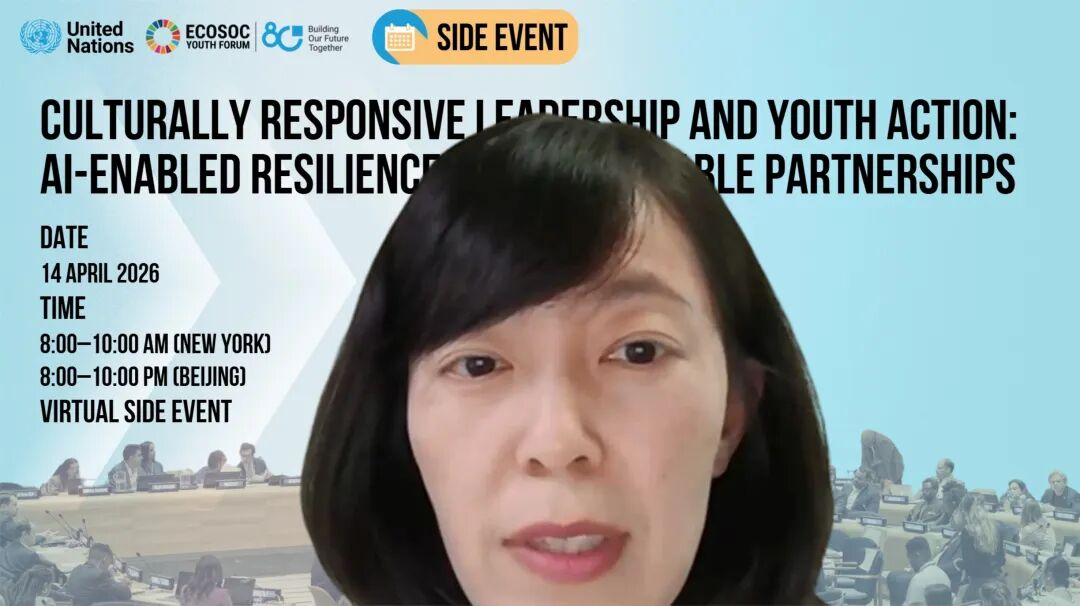
NEW YORK, NY, UNITED STATES, April 16, 2026 /EINPresswire.com/ — April 14, 2026 — Speakers at an official side event of the 2026 U.N. Economic and Social Council Youth Forum called for culturally responsive leadership, stronger youth action and more locally grounded, trust-based use of artificial intelligence to advance ESG resilience and sustainable partnerships.
The online event, titled “Culturally Responsive Leadership and Youth Action: AI-Enabled Resilience and Sustainable Partnerships,” was co-organized by the United Nations University Institute in Macau, the Grouphorse ESG Center at the School of Foreign Languages of Southwest Petroleum University, and the Shanghai Qibao High School Educational Group. Held in English and Chinese with simultaneous interpretation, the forum was part of the official program of the 2026 ECOSOC Youth Forum and focused on this year’s U.N. review of Sustainable Development Goals 6, 7, 9, 11 and 17.
Speakers said one of the central challenges facing the international community is how to move from setting goals to delivering results at the local level. In opening remarks, Min Yang of UNU Macau said the world remains marked by geopolitical fragmentation, inequality and climate stress despite growing interconnectedness, and argued that cross-cultural understanding is essential to peace and sustainable development. She described young people as more than participants in the digital era, saying they are a bridging force between tradition and modernity, as well as between local realities and global agendas.
Xing Tang, founder of Grouphorse Group and executive director of the Grouphorse ESG Center at Southwest Petroleum University’s School of Foreign Languages, said the discussion was not simply about artificial intelligence as a tool, nor about youth participation as a slogan. Instead, he said, the focus was on how culturally responsive leadership can connect youth action, trusted data, project design and cross-sector collaboration, helping sustainable development shift from one-off events to more durable systems of delivery. He added that for young people to play a real role, they need not only enthusiasm but also pathways, tools, trust and opportunities to act.
Stanford University professor Michael Shanks said the central obstacle to sustainable development is not a lack of technology but a lack of understanding of people, culture and relational networks. He presented “design foresight” as an operational method that shifts attention from simply solving problems to understanding communities, and from predicting the future to recognizing longer-term patterns of change. Sustainable development, he argued, should be treated as a “living system” shaped by relationships, experience and collaboration. In that framework, AI can accelerate information processing and action, but communities still determine meaning, direction and legitimacy.
Tang later delivered a keynote using the strategy game Go, or weiqi, as a framework for youth leadership in the AI era. Referring to the pressure that algorithms and fragmented attention place on judgment and independent thinking, he argued that young people now need two core capacities: “strategic cognition,” or the ability to read complexity and maintain direction, and “resilient delivery,” or the ability to keep advancing despite disruption and uncertainty. He also called for greater international attention to and institutional support for the inclusion of Go in UNESCO’s intangible cultural heritage framework, describing it as a cultural and educational resource with cross-cultural value in youth capacity-building.
U.N. project design consultant Yujie Chen said sustainable development projects often fail not because they lack frameworks or funding, but because they are poorly adapted to local social structures and cultural conditions. She proposed what she called “four shifts”: from delivering for communities to co-designing with them; from using AI as a substitute for judgment to treating it as an accelerator of delivery; from seeing youth as beneficiaries to recognizing them as co-designers; and from event-centered planning to continuity-centered planning. She urged organizations to ask from the beginning who will carry a project forward years later and what mechanisms will survive after initial funding ends.
A youth project showcase featured six student delegates from schools within the Shanghai Qibao High School Educational Group. From Xindu Experimental School Affiliated to Shanghai Qibao High School, Tianyi Zhu explored how traditional cultural motifs and geometric structures could inform renewable energy design, while Yuqi Huang presented a low-cost, community-based approach to monitoring the impact of cooking-oil waste on aquatic ecosystems. From Shanghai Qibao High School Pujiang Branch, Yizhou Li examined how artificial intelligence could help expand access to education for disadvantaged groups, while Lingyu Lu focused on fairness in AI-driven learning and the need for young people to retain agency in the use of algorithmic tools. From Shanghai Qibao High School, Haowei Shi presented a project on digital assistance for older adults as a channel for more inclusive community governance, and Zhining Zhuang introduced ideas for green public space revitalization and a “Community ESG Ledger” to strengthen accountability and resilience at the neighborhood level. Organizers presented the projects as evidence that young people are already developing practical, locally grounded responses to sustainability challenges.
In a special session on women’s leadership, Liya Hou, Officer of Research at Columbia Business School, argued that women’s leadership should be understood not as a symbolic goal but as an operational governance capacity. She said resilient systems under pressure depend on inclusive planning, credible risk communication and coordination across institutions, and proposed evaluating leadership by asking who is protected, who is persuaded and who is able to execute collaboratively under strain. She called for governance structures that give women real decision-making authority and measurable responsibility in delivery systems.
Across the event, speakers returned to a common conclusion: AI-enabled sustainable development will depend not only on technical capacity, but also on whether systems are designed to respond to culture, community realities and local knowledge. Youth participation, they said, must move beyond expression and consultation toward genuine authority, institutional trust and long-term collaboration in delivery.
XING TANG
Grouphorse ESG Center, School of Foreign Languages, Southwe
email us here
Legal Disclaimer:
EIN Presswire provides this news content “as is” without warranty of any kind. We do not accept any responsibility or liability
for the accuracy, content, images, videos, licenses, completeness, legality, or reliability of the information contained in this
article. If you have any complaints or copyright issues related to this article, kindly contact the author above.

Media gallery