
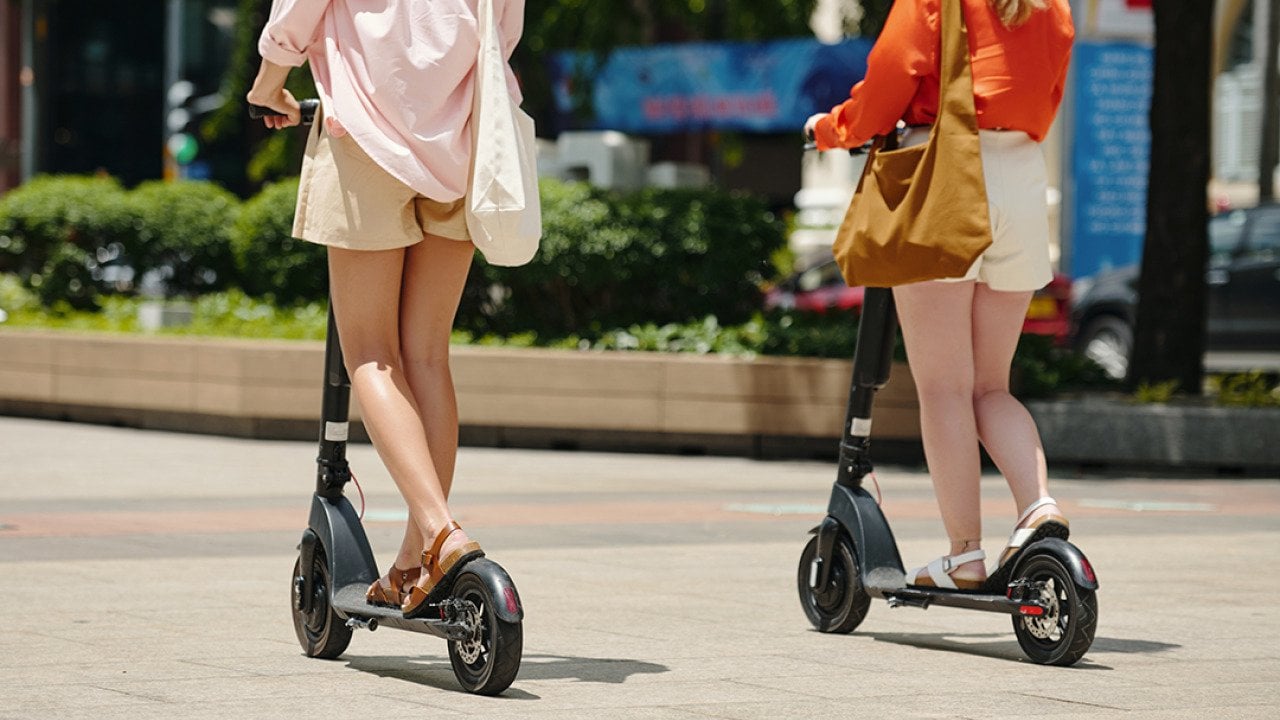
Dragon Images // Shutterstock
Where e-scooters are legal and where they’re restricted in the US
Electric scooters have gone from novelty to everyday transportation in many American cities, but the rules governing where they can be ridden still vary sharply from state to state. The result is a patchwork of laws that can change from one jurisdiction to the next, with differences over speed limits, helmet rules, minimum rider ages, sidewalk riding, and whether local governments can make their own restrictions.
Most states that have addressed e-scooters in law now treat them as a distinct type of micromobility device rather than as mopeds or motorcycles. But “legal” does not always mean riders can use them everywhere. In many places, state law allows e-scooters on certain streets or bike facilities while leaving cities and counties free to decide whether they belong on sidewalks, trails, or higher-speed roads.
THE702FIRM Injury Attorneys, a personal injury law firm, reviewed state transportation statutes and agency guidance, as well as national legislative and safety data, regarding e-scooter laws.
A growing number of states now have e-scooter laws on the books
According to NCSL’s latest 50-state legislative review, 28 states and Washington D.C., have enacted e-scooter laws addressing issues such as minimum age, speed, and roadway use. Those states are:
- Alabama
- Arizona
- Arkansas
- California
- Colorado
- Connecticut
- Florida
- Hawai’i
- Illinois
- Indiana
- Kansas
- Kentucky
- Louisiana
- Maryland
- Minnesota
- Mississippi
- New Jersey
- Nevada
- New York
- Oklahoma
- Oregon
- South Dakota
- Tennessee
- Texas
- Utah
- Virginia
- Washington
- Wisconsin
That still leaves a split national landscape. In states that have passed micromobility laws, riders usually get a clearer answer about where e-scooters fit. Elsewhere, riders can run into older vehicle codes that were written before stand-up scooters became common, or into rules that effectively bar them from public roads because they cannot be registered like other motor vehicles.
Where e-scooters are clearly legal, riders still face tight limits
California is one example of a state where e-scooters are clearly legal but tightly regulated. The California Highway Patrol says scooters may not exceed 15 mph. They may be used on a bicycle path, trail, or bikeway unless prohibited, and on roads over 25 mph only if the rider uses a Class II bicycle lane. California also requires a Class C driver’s license or permit, helmets, and a minimum rider age of 16.
Nevada statute is also fairly clear on where scooters can be used. Under NRS 484B.785, an electric scooter may be operated on a roadway, bicycle lane, path, or route at no more than 15 mph, and on a sidewalk or other pedestrian area at whatever speed limit is set by local ordinance, if any. The same statute says e-scooters are generally subject to the laws that apply to bicycles and electric bicycles.
New York also allows e-scooters, but not everywhere. The state DMV says riders can operate them on streets and highways with posted speed limits of 30 mph or less, while municipalities can impose additional rules on the time, place, and manner of operation. Sidewalk riding is prohibited unless a local law permits it, and the DMV notes that operating an e-scooter at speeds above 15 mph is illegal. In New York City, the Department of Transportation says scooters may be ridden in bike lanes and on streets with speed limits of 30 mph or less, but not on sidewalks.
Florida takes a somewhat more permissive statewide approach. Under Florida Statute 316.2128, operators of motorized scooters and micromobility devices have the same rights and duties as bicycle riders in most respects, and the law says riders do not need a driver’s license, vehicle registration, or insurance solely to operate one. But the same statute also preserves local authority to regulate or restrict where scooters can be used on streets, highways, sidewalks, and sidewalk areas.
New Jersey’s micromobility rules likewise reflect that in-between approach. State guidance says low-speed electric scooters are not subject to a minimum age requirement under state law, though helmet rules apply to riders under 17, and local governments may create additional operating rules.
Sidewalks remain one of the biggest dividing lines
One of the biggest legal fault lines is whether e-scooters belong on sidewalks. NCSL’s review found that Minnesota does not permit e-scooters on sidewalks except when needed to enter or leave property, while 11 states allow local governments to decide whether sidewalk riding is permitted
- Hawai’i
- Illinois
- Indiana
- Kansas
- Louisiana
- Maryland
- Nevada
- New York
- Texas
- Utah
- Virginia
That distinction matters because available safety research suggests riders often shift between roadways, bike lanes, and sidewalks depending on traffic conditions and local rules. NCSL, citing federal and academic research, says 63% of injuries in one CPSC report occurred on roadways versus 29% on sidewalks, while riders often choose sidewalks when bike lanes are unavailable, and vehicle traffic feels heavy. NHTSA has also noted that many e-scooter crashes are single-vehicle incidents that occur on sidewalks or in areas with poor pavement conditions.
In some states, public road use remains heavily restricted
Not every state has embraced e-scooters as a standard mode of transportation. In Pennsylvania, PennDOT says a motorized scooter is a two-wheeled vehicle powered by an engine or electric motor without a seat or saddle. Because those vehicles do not comply with the state’s equipment and inspection requirements for motor vehicles, PennDOT adds that they cannot be titled or registered in the commonwealth and cannot be operated on Pennsylvania roadways or sidewalks.
Delaware also remains restrictive. Under Delaware law, “motorized skateboards or scooters” generally may not be operated on a public highway, street, sidewalk, or right-of-way in the state, with narrow exceptions spelled out in statute.
Those rules underscore a broader point in the U.S. e-scooter landscape: in some states, the central legal question is how scooters may be used, while in others it is whether they can be used on public ways at all.
Why the legal map is still shifting
The pace of lawmaking suggests the issue is still evolving. NCSL says most states that have enacted e-scooter laws did so only in recent years, with 18 passing legislation in 2019 alone and several others revising their rules since 2020. The same report says lawmakers have focused on speed, roadway access, age minimums, and operator behavior as states try to fit a newer device into transportation systems built around cars, bikes, and pedestrians.
That legal uncertainty comes as injuries continue to draw public attention. The CPSC said micromobility-related injuries rose nearly 21% in 2022 from 2021, and its safety center warns that emergency room-treated injuries and deaths tied to e-scooters, e-bikes, and hoverboards have been increasing.
For riders, that means the answer to whether e-scooters are “legal” in the U.S. is often yes, but only on certain streets, at certain speeds, under certain age and helmet rules, and sometimes only if a city has chosen to allow it. In practice, the safest assumption is that legality does not travel well across state lines, and sometimes not even across town lines.
This story was produced by THE702FIRM Injury Attorneys and reviewed and distributed by Stacker.