
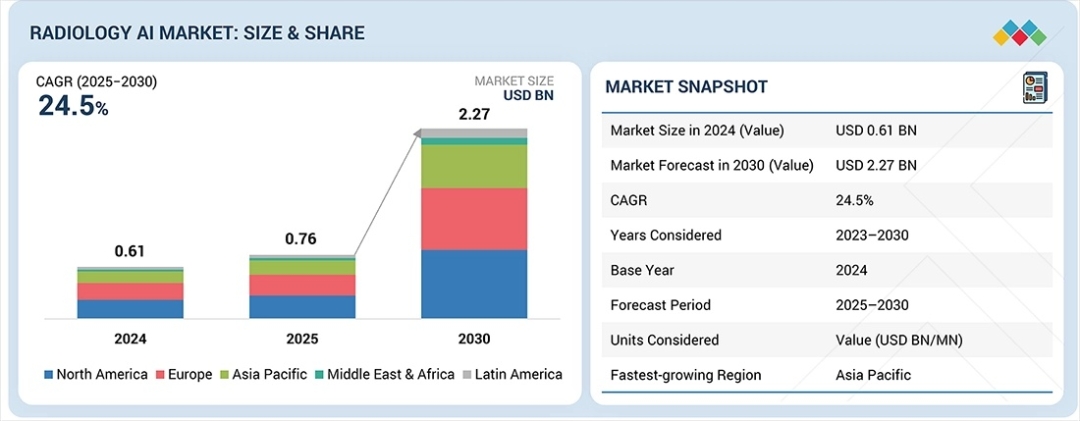
The global Radiology AI Market is poised for significant expansion, with valuations projected to rise from USD 0.76 billion in 2025 to USD 2.27 billion by 2030. This robust growth, characterized by a CAGR of 24.5%, is primarily fueled by a critical global shortage of trained radiologists and an unprecedented surge in patient imaging volumes. As healthcare systems shift toward precision medicine, the demand for AI-driven solutions that can triage critical cases, automate routine administrative tasks, and provide high-accuracy diagnostic support has become a necessity rather than a luxury. Key market drivers include the rising incidence of chronic conditions particularly in oncology and neurology and the increasing integration of AI within standard hospital workflows to alleviate clinician burnout and reduce diagnostic turnaround times.
Download PDF Brochure:https://www.marketsandmarkets.com/pdfdownloadNew.asp?id=231900847
Technological Evolution and the Shift Toward SaaS-Based Orchestration
The structural composition of the market is witnessing a decisive shift toward Software-as-a-Service (SaaS) and cloud-native deployments. In 2024, the software segment held the dominant market share due to its inherent scalability and lower barrier to entry compared to hardware-embedded AI. Healthcare providers are increasingly favoring platform-based models that integrate seamlessly with existing PACS (Picture Archiving and Communication Systems) and EHR (Electronic Health Records) infrastructures. This shift allows for continuous algorithmic updates and remote performance monitoring without requiring expensive capital equipment overhauls.
Furthermore, the rise of multi-modal AI integration is redefining the diagnostic landscape. Modern AI tools are no longer limited to isolated image analysis; they are evolving to synthesize data from genomics, laboratory results, and wearable devices. This holistic approach enables radiologists to move toward “outcome-driven” care. High-impact innovations, such as the collaboration between Philips and NVIDIA to develop large foundation models for MRI, illustrate the industry’s commitment to zero-click scan planning and automated interpretation. By reducing the manual burden of image reconstruction and denoising, these technologies allow clinical staff to focus on complex patient management, effectively addressing the “workload-capacity gap” currently plaguing global health systems.
Modality Leadership and the Dominance of CT and Oncology Applications
Among various imaging modalities, Computed Tomography (CT) continues to hold the largest market share. This dominance is supported by the high utilization of CT scans in emergency and time-sensitive care environments, such as trauma, stroke, and cardiovascular units. AI-powered CT solutions offer tangible benefits in lesion detection, segmentation, and radiation dose optimization, which are critical for patient safety and diagnostic speed. Closely following CT is the Magnetic Resonance Imaging (MRI) segment, which is benefiting from AI-driven reconstruction techniques that significantly reduce scan times, thereby increasing patient throughput and comfort.
From an indication perspective, Oncology remains the largest segment during the forecast period. The global burden of cancer requires frequent and high-precision longitudinal monitoring, where AI excels at tracking volumetric tumor changes and identifying subtle biomarkers that might be missed by the human eye. Neurology also accounts for a substantial share, driven by the urgent need for rapid stroke intervention and the growing prevalence of neurodegenerative diseases like Alzheimer’s. In these fields, AI functions as a “digital teammate,” providing real-time triage and prioritization of life-threatening findings. Leading industry players like GE HealthCare, Siemens Healthineers, and Fujifilm are at the forefront of this movement, embedding deep-learning algorithms directly into their hardware portfolios to ensure that intelligence is delivered at the point of acquisition.
Request Sample Pages-https://www.marketsandmarkets.com/requestsampleNew.asp?id=231900847
Regional Growth Dynamics and the Ascendance of Asia Pacific
While North America currently dominates the Radiology AI Market with a nearly 40% share attributed to advanced digital infrastructure and supportive regulatory frameworks like the FDA’s evolving AI/ML guidelines the Asia Pacific region is emerging as the fastest-growing market. This acceleration is driven by rapid digital health modernization in countries like China, India, and Japan. These nations face an acute shortage of radiologists relative to their massive and aging populations, creating a fertile ground for AI-enabled workflow automation.
Government initiatives, such as national AI roadmaps and reimbursement reforms, are further lowering the barriers to adoption in the Asia Pacific. Strategic collaborations, such as the partnership between Siemens Healthineers and Apollo Hospitals in India, highlight a growing focus on using AI for early disease detection and risk stratification in emerging markets. Despite challenges such as high implementation costs and the complexities of integrating with legacy IT systems, the long-term ROI of AI is becoming undeniable. As healthcare systems worldwide transition to value-based care, the integration of Radiology AI will remain a cornerstone of operational efficiency, diagnostic accuracy, and improved patient outcomes.
Media Contact
Company Name: MarketsandMarkets™ Research Private Ltd.
Contact Person: Mr. Rohan Salgarkar
Email: Send Email
Phone: 18886006441
Address:1615 South Congress Ave. Suite 103, Delray Beach, FL 33445
City: Florida
State: Florida
Country: United States
Website: https://www.marketsandmarkets.com
Press Release Distributed by ABNewswire.com
To view the original version on ABNewswire visit: Radiology AI Market to Reach USD 2.27 Billion by 2030
